
Sustainable Fashion as a Solution to the Fashion Industry's Impact on Wastefulness
7 min read · Written on November 15, 2025
Introduction
Sustainable fashion has become more of a need than a preference. To understand this statement better, we need to explore the underlying problem: fashion industry-generated wastage and its impact.
Fashion industry’s waste arises predominantly from the raw material, factory, retail, and finally, consumer phases. It begins from the natural resources expended to gather the raw material. The manufacturing phase generates waste like damaged, scrap, or excess raw material, wrongly dyed fabrics, material trimmings; dead stock (unsold items) make up the retail waste. At the consumer level, waste typically constitutes discarded garments.
Background
The cultivation of conventional cotton (a natural fiber) is water-intensive. To give some perspective, the yarn required for a single cotton T-shirt consumes 2,700 L of water to grow — sufficient drinking water for an individual for 2.5 years! The subsequent steps of yarn preparation and fiber production are energy-consuming.
However, synthetic textiles (particularly polyester) derived from petrochemicals offer attractive properties like low production cost, elasticity, crease resistance, and quick drying, which have largely replaced natural fibers and make up nearly 70% of the raw material used.
The availability of a cheaper source of textiles boosted fast fashion. At the other end, sales are boosted by tempting the masses with inexpensive alternatives to the hottest high-end collections. The endorsement of such collections by celebrities — and more recently — social media influencers further exacerbate the issue as customers flock to markets to keep up with the latest trends. Not long after, the latest buy becomes ‘outdated’ and finds itself in an incinerator, or worse yet, an over-crowded landfill. Sadly, almost 30% of all clothes manufactured globally are never sold owing to the shrinking gap between the launch of each new collection.
One might expect prestigious luxury brands to display some level of responsibility. To much dismay, leaked reports have unveiled how certain big names have burned their unsold stock worth millions in dollars. Common justifications include: preservation of brand value and obstruction of counterfeiting. Apparently, our planet is a small price to pay in the face of brand worth.
Fast fashion was introduced as a means to make trendy clothing, affordable and easily accessible to all. Cheaper and quickly manufactured clothing meant shoddier quality, hence, a shorter life span. It is estimated that almost a hundred billion garments are manufactured each year with 85% of these being discarded. And where do these end up?
While a fraction is burned in incinerators, a major chunk is chucked in landfills. Or better yet, shipped off to under-developed nations in Africa disguised as donations or for recycling. Now, I’m sure the donors have pure intentions and don’t know any better but nearly a third of such exports are in a state so ragged that they doubtlessly qualify for disposal. What’s more, with the rate of textile production superseding its demand, the bulk of clothing getting shipped has become unmanageable for the local vendors— merely adding to the ever-rising peaks of discarded clothing.
The Impact of Fashion Industry’s Wastage
The fashion industry is among the biggest contributors to air and water pollution. Waste water with harsh chemicals from dyed fabrics is drained in water bodies without proper treatment. Production of synthetic textiles is an energy-consuming procedure and is associated with environmental harms, such as greenhouse gas/methane emissions, oil spills, air and water pollution.
Incineration itself, releases noxious fumes that pollute the air and are detrimental to health. The essentially non-degradable synthetic textiles continue to rot in landfills, releasing harmful dyes, chemicals, and polluting rivers and seas. Furthermore, synthetic fibers disintegrate into micro-plastics that enter the marine ecosystem, accumulate in the aquatic life and become a part of the its food chain.
Recycling garments that are a blend of natural and synthetic fibers (polyester-cotton) is a major challenge as fiber types need to be separated prior to recycling.
Sustainable Fashion – The Solution?
Sustainable fashion is a growing movement that aims to introduce environment consciousness and ethical practices in the fashion industry.
Sustainable practices strive to circularize the otherwise linear business model of manufacturing and disposing garments. By recycling garments into raw materials for new textile products, the linear phase is transformed into a closed, circular loop.
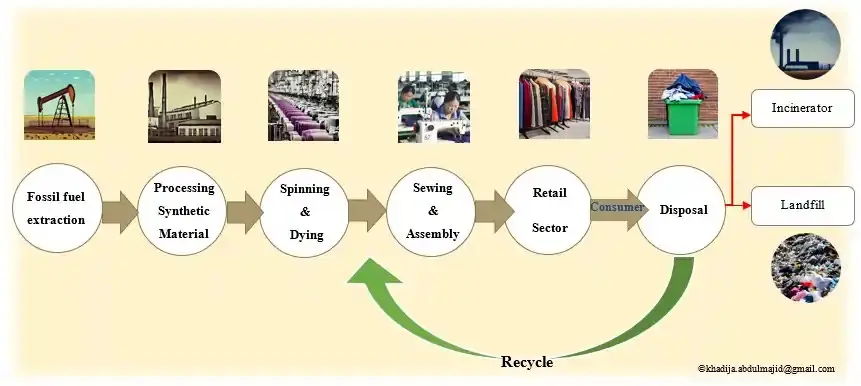
In terms of raw materials, biodegradable raw materials or recycling textile waste is encouraged. Examples of eco-friendly raw materials include fiber from hemp, regenerative cotton, and agricultural waste (rinds or leaves – wheat straw, rice husks, etc.), these consume lower quantities of water and do not need to be processed by chemicals of any sort.
Sustainable wear doesn’t have to be bland and boring. Natural dyes are biodegradable and renewable sources of coloring substances. They can originate from plants (leaves, roots, barks, etc.), animals (arthropods), minerals and microorganisms (algae, bacteria and fungi) and impart colors ranging from deep blues, to various shades of red, hues of yellow and indigo among others. Knowledge of preparing and applying natural dyes have been a part of various traditions and cultures around the world.
Another means to promote sustainability is to reduce waste by practices like up-cycling, re-purposing or recycling.
Up-cycling an article of clothing involves repairing any damages and converting/upgrading into a similar or new and improved version of that article.
Re-purposing entails transforming a piece of clothing into something else entirely (t-shirt to tote bag).
Whereas in recycling, the article is broken down to its raw elements to be used either in creating the same piece of clothing from scratch or down cycling into a product of lower value like furniture stuffing.
While these practices are gradually coming into implementation in the developed world, the under-developed nations have an even greater need. A lot of discarded clothing is shipped off to these nations to be sold as secondhand clothing. With the rise in production and subsequent disposal of clothing, the bulk being shipped and dumped in these regions has also risen.
Luscious landscapes, wildlife or indigenous communities, Africa hosts/boasts of its rich diversity. Any hope left to conserve this beautiful land hinges on how the fashion industry’s waste is managed.
Based in Uganda, The Larry Rowb’s Foundation is one of the African organizations working to reverse or rather solve this massive problem.
Their goal is to establish a recycling plant that converts suitable textile discard into eco-friendly and trendy wear for Africans. Along with this, centers for education and training will also be set up. The goal is to empower the African populace with awareness and to coach or equip them with the knowledge and facilities to manage, develop, and upscale this process — in short, to educate Africans and to provide them safe and ethical working environment.
What Can You as a Consumer Do?
Consumers can support any of the numerous startups and businesses that offer recycling, thrifting or renting services instead of discarding clothes.
When buying
Buy according to the need.
Prioritize quality over quantity.
Buy from brands that are verifiably sustainable.
Opt for garments made up of single fiber type and natural fiber.
Wash items only as needed.
Repair and reuse so they last longer.
Join us and play a more active role as we work towards a greener, more sustainable future for Africa and the world.
References
Cho, Renee. (2021) 'Why Fashion Needs To Be More Sustainable?', Columbia Climate School, 21st June.
Igini, Martina. (2022) '10 Concerning Fast Fashion Waste Statistics', Earth.org, 2nd August.
Rauturier, Solene. (2022) 'Everything You Need to Know About Waste in the Fashion Industry', good on you, 21st February.